
GEXNO / Guides / JSON to Java POJO: Generate Jackson/Gson-Compatible Classes Online
JSON to Java POJO: Generate Jackson/Gson-Compatible Classes Online
Got a pile of JSON from a third-party API? Convert it to Java POJOs / Records online — nested objects and arrays supported, and the code never leaves your browser.
Why you need JSON-to-Java generation
Integrating a third-party API, wiring up a frontend, consuming an open platform — step one is always turning the JSON shape into strongly typed code. Hand-writing hurts in very specific ways: too many fields, deep nesting, mixed naming styles (snake_case vs camelCase), and a full rewrite every time the contract changes.
A generator turns it into paste → copy, with type inference, nested-class splitting and getters/setters done automatically.
Up and running in 30 seconds
Open the JSON to Java tool in GEXNO Tools, paste the API sample on the left, and the matching Java classes appear on the right — one click to copy into your project.
The conversion runs in your browser. API samples often contain real user data and token shapes; local processing means that never leaves your machine.
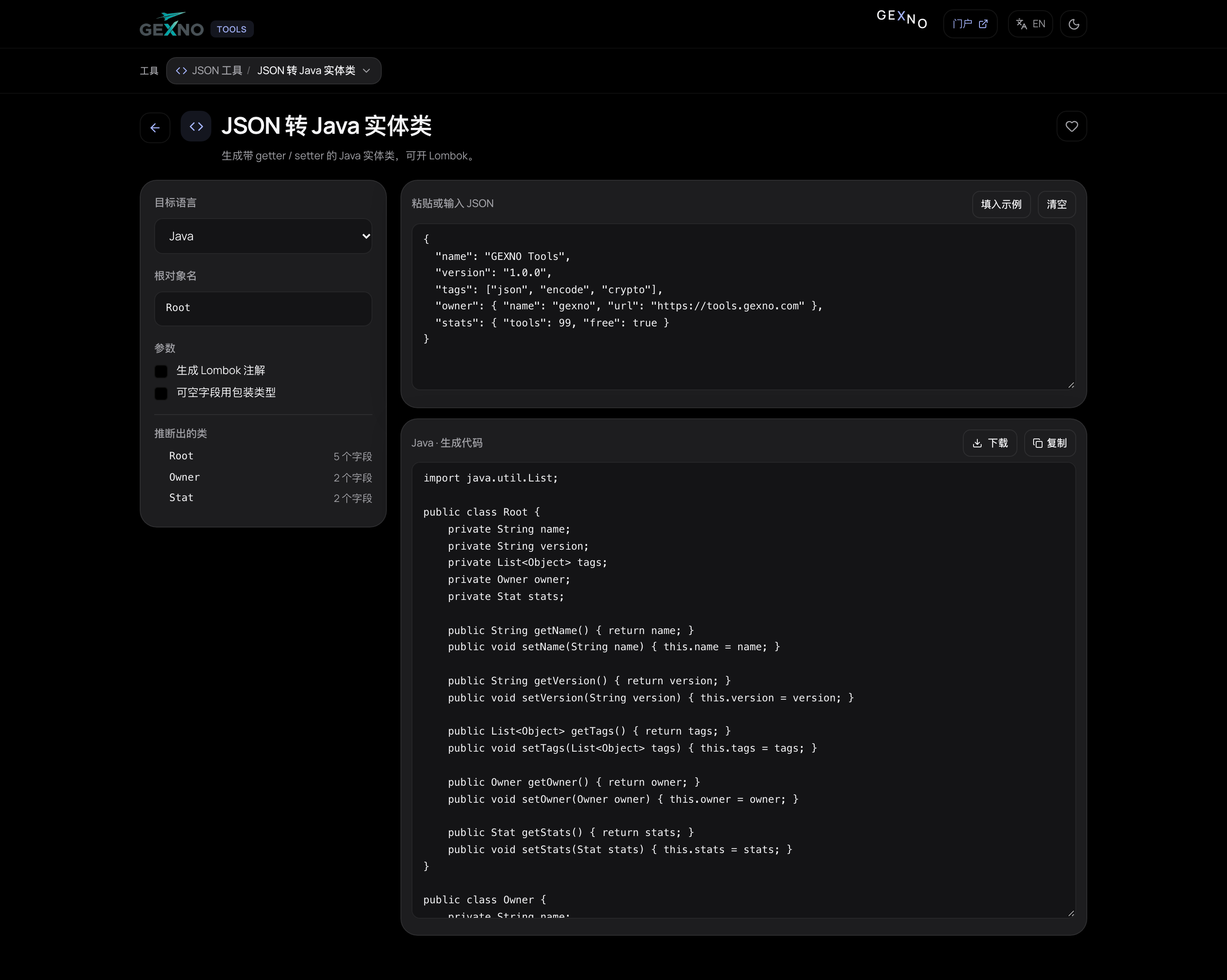
What the generated code looks like
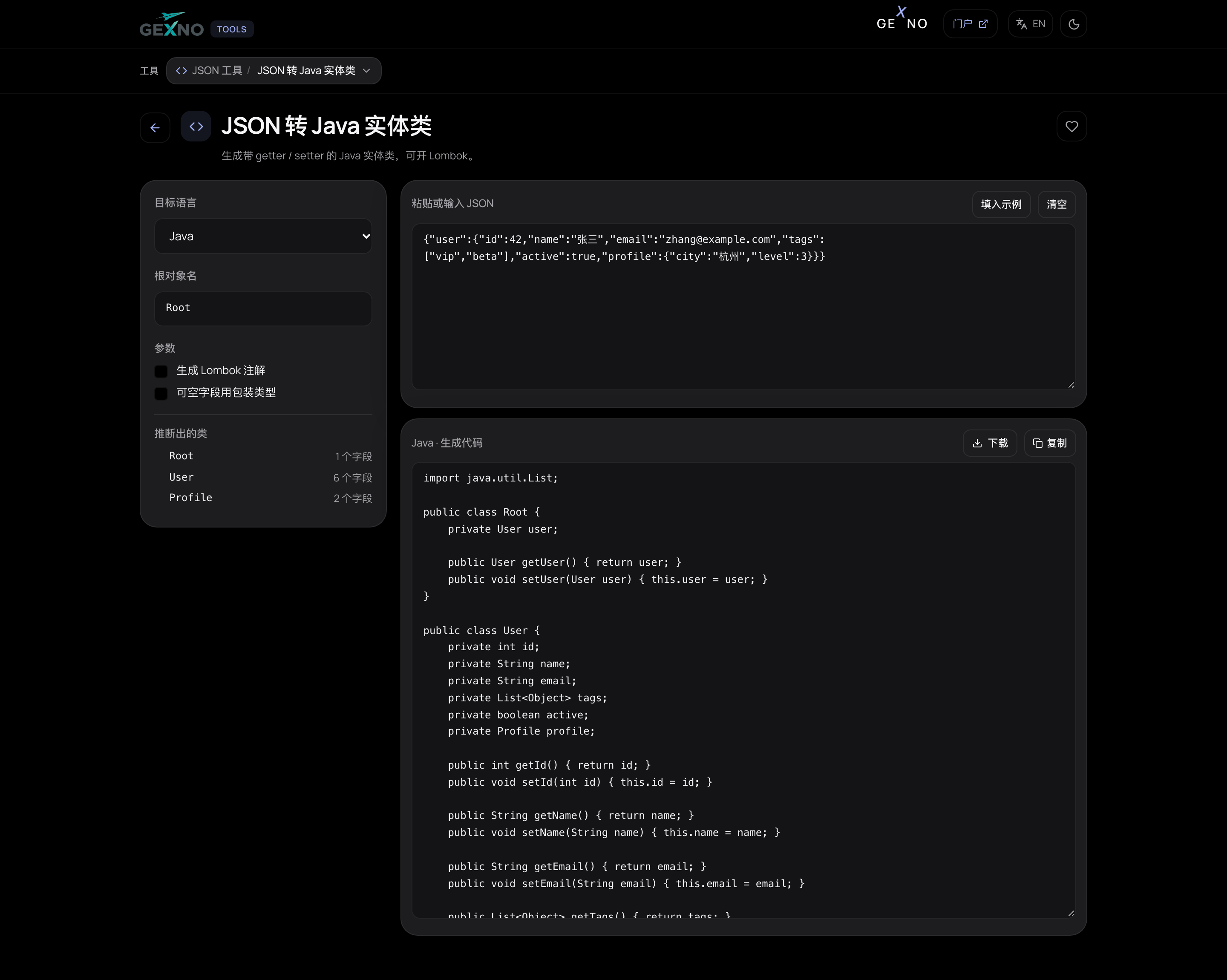
For a user-info payload the tool produces standard POJOs with private fields and getters/setters: nested objects become separate classes (the sample generates Root, User and Profile), arrays map to List, and null fields map to wrapper types (Integer/Boolean) instead of primitives, avoiding NPEs during deserialization.
Wiring it into Spring Boot / Jackson
The generated POJOs work with Jackson and Gson out of the box. In Spring Boot, @RequestBody binds request bodies straight onto them; for third-party responses use ObjectMapper.readValue(json, User.class).
Two practical tips: add @JsonIgnoreProperties(ignoreUnknown = true) so new upstream fields don't break deserialization, and map mismatched names explicitly with @JsonProperty instead of guessing.
Record or classic POJO?
- Classic POJO: mutable fields, compatible with older frameworks — pick it when the team writes setter-style code.
- Java 16+ Record: a one-line immutable data carrier, ideal for DTOs and API responses, natively supported by Jackson.
- Either way, generate first and tweak to your team's conventions — always faster than hand-writing.
FAQ
Will converting JSON to Java classes leak my API data?
It depends on the tool. GEXNO Tools runs the conversion locally in your browser — pasted JSON is never uploaded, so samples with real data are safe.
Does the generated code work with Jackson and Gson?
Yes. It's standard POJO structure that Jackson, Gson and Fastjson deserialize directly; add @JsonProperty or @SerializedName when field styles differ.
How are nested objects and arrays handled?
Nested objects become separate classes (the sample generates Root, User and Profile); arrays map to List with element types refined manually as needed; null fields map to wrapper types to avoid primitive NPEs.
Can it generate Lombok-annotated code?
Check the tool's current output; if not supported, adding @Data or @Getter/@Setter to the generated POJO takes seconds.
How do I map snake_case fields to camelCase?
Either rename the fields after generation and annotate with @JsonProperty("original_name"), or camelCase the JSON keys first and let the annotation handle the wire format.